The Decision-Stage Blind Spot: Why Brands Lose Pipeline at the Final AI Hurdle
By Alex | Content Strategy | 10 min read
Brands lose pipeline because AI visibility collapses at the decision stage. Data shows a 37-point drop from awareness to purchase intent. Three-phase strategy to fix it.
Tags: LLM Visibility, AI Buying Journey, Decision Stage, Content Strategy, Pipeline, Brand Visibility, ChatGPT, Contxt
Your brand shows up when buyers ask ChatGPT what your category is. It appears when they explore options. But when they ask the question that actually matters , "which one should I buy?" , you vanish.
This is the decision-stage blind spot, and it is quietly costing businesses more pipeline than most CMOs realise. We have analysed hundreds of brands through Contxt and the pattern is consistent: visibility collapses at the exact moment a buyer is ready to commit.
This article breaks down why it happens, what the data shows, and how to close the gap before competitors cement their position.
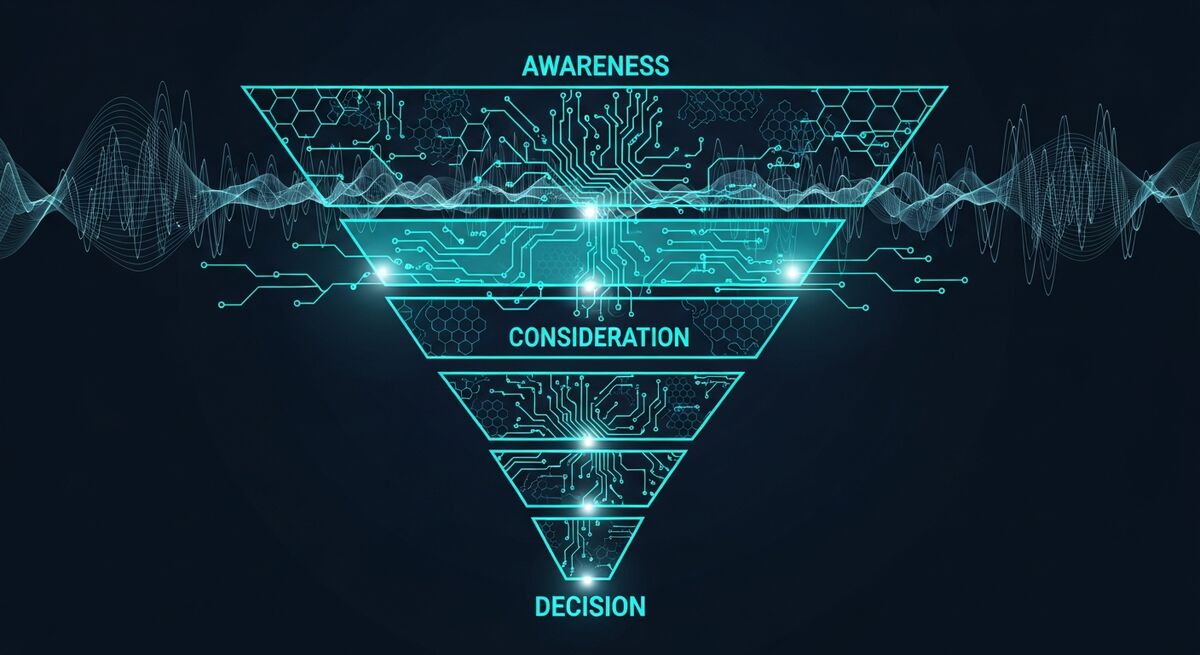
The Three-Stage Visibility Cliff
When we scan a brand through Contxt, we run real buyer queries across ChatGPT, Google AI Overview, Claude, Perplexity simultaneously. We group those queries into three buying journey stages:
- Awareness: "What is [category]?" / "Best ways to solve [problem]"
- Consideration: "[Brand] vs [Competitor]" / "Top tools for [use case]"
- Decision: "Should I buy [Brand]?" / "Is [Brand] worth it for my team?"
Across every industry we have analysed , SaaS, professional services, e-commerce, B2B manufacturing , the pattern is remarkably consistent:
| Buying Stage | Average Brand Visibility | Revenue Impact |
|---|---|---|
| Awareness | 64% | Low , buyers are exploring |
| Consideration | 43% | Medium , shortlists are forming |
| Decision | 27% | Critical , purchase intent is highest |
That 37-point drop from awareness to decision is not a minor detail. It means the majority of brands are visible when buyers are casually browsing but invisible when those same buyers are ready to spend money.
Why Decision-Stage Visibility Collapses
The reason is structural, not accidental. Most brands invest their content budgets in top-of-funnel material: thought leadership, educational guides, industry trend pieces. This content performs well for awareness queries because it is exactly what LLMs surface when buyers ask broad, exploratory questions.
But decision-stage queries require fundamentally different content. When a buyer asks "should I choose [Brand] for my 200-person team," the AI assembles its answer from:
- Detailed pricing and plan comparison pages
- Implementation guides and onboarding documentation
- Customer case studies with measurable outcomes
- ROI frameworks and business case templates
- Enterprise-specific feature breakdowns
- Honest comparison pages acknowledging trade-offs
Most brands have little or none of this published. Their websites jump from "here is what we do" to "book a demo" , leaving a content vacuum that AI assistants fill with competitor material or generic recommendations.

The Cross-Platform Amplification Problem
The decision-stage blind spot is bad enough on one platform. But it compounds across multiple AI assistants because each platform has different training data, different citation preferences, and different ways of handling purchase-intent queries.
In our Contxt analyses, we consistently see brands with wildly different visibility profiles across platforms:
- Google AI Overview tends to favour brands with strong structured data and fresh content , it pulls heavily from indexed web pages
- ChatGPT draws from its training data and, increasingly, real-time web search , meaning outdated content actively works against you
- Perplexity is citation-driven and favours recently published, well-structured content with clear data points
- Claude tends to give balanced, measured responses and leans towards content that acknowledges multiple perspectives
A brand might have 55% decision-stage visibility on Google AI Overview but only 15% on Perplexity. If you are only monitoring one platform, you are seeing a fraction of the picture , and your competitors might be dominating the platforms you are not watching.
Real Pipeline Impact: A Worked Example
Consider a B2B SaaS company with an average contract value of £25,000. They receive approximately 400 AI-influenced enquiries per quarter across all platforms (a conservative estimate for a mid-market brand in 2026).
With 64% awareness visibility, around 256 potential buyers encounter their brand during initial research. By the consideration stage, that drops to 172 (43% visibility). At the decision stage , where conversion probability is highest , only 108 of those buyers see the brand recommended (27% visibility).
The 148 buyers who encountered the brand at awareness but lost it at decision? They converted for someone else. At a 15% close rate on decision-stage recommendations, that represents 22 lost deals worth £550,000 per quarter.
Scale that to annual figures and the decision-stage blind spot represents over £2 million in lost pipeline. For a single mid-market brand. In a single category.
The Three-Phase Fix
Closing the decision-stage gap is not a single campaign , it is a systematic content build. Based on hundreds of Contxt analyses, here is the phased approach that consistently works.

Phase 1: Gap Closure (Weeks 1-4)
Start with the highest-impact gaps. Use Contxt's content gap analysis to identify the specific decision-stage queries where you are invisible but competitors are recommended. For each gap:
- Review what competitors published that earned them the AI recommendation
- Generate a targeted content brief using Contxt's AI-powered brief generator
- Publish content that directly addresses the buyer's purchase-intent question
- Include specific, quotable data points and clear feature comparisons
Priority targets: pricing comparison pages, implementation guides, and customer evidence pages. These have the highest correlation with decision-stage AI recommendations.
Phase 2: Journey Coverage (Weeks 5-8)
Once the critical decision-stage gaps are closed, expand coverage across the full buying journey. The goal is consistent visibility from first question to final purchase decision:
- Strengthen consideration-stage content with honest comparison pages
- Build "bridge" content that naturally guides buyers from awareness to decision
- Add internal linking between journey stages so AI models can trace the full path
- Optimise existing content for AI citation patterns , clear headings, structured data, definitive statements
Phase 3: Category Authority (Weeks 9-12)
With gaps closed and journey coverage in place, build the content moat that makes your position durable:
- Publish original research and data that competitors cannot replicate
- Create definitive category guides that AI models treat as authoritative sources
- Develop content in emerging subtopics before competitors claim them
- Monitor weekly and respond to any visibility drops within 48 hours
How Contxt Makes This Measurable
The biggest challenge with LLM visibility is that you cannot fix what you cannot measure. Traditional SEO tools track Google rankings. Social tools track engagement. But nothing tracks what AI assistants actually say about your brand , until now.
Contxt gives you:
- Category Position Verdict: Are you a Category Leader, Emerging Contender, Under the Radar, or Invisible? One metric, instantly actionable
- Buying Journey Heatmap: Visibility broken down by Awareness, Consideration, and Decision , so you know exactly which stage is leaking pipeline
- Cross-Platform Scanner: How your brand appears across ChatGPT, Google AI, Claude, Perplexity simultaneously
- AI Content Briefs: For every gap, we analyse what competitors published and generate the brief you need to close it
- Competitor Intelligence: Track every competitor's visibility alongside yours, with automated alerts when someone overtakes you
Your first visibility report takes under five minutes. No setup calls, no onboarding sessions , just data.
Start your free Contxt scan and see exactly where your brand disappears from the AI buying journey.
Further Reading
- The 3 Types of Prompt That Decide Whether AI Recommends You or Your Competitor
- Keywords vs Prompts: Why Your SEO Content Strategy Will Not Work for AI Visibility
- We Ran 4,500 AI Prompts Across 349 Brands. Two-Thirds Are Invisible.
Track how your brand appears across ChatGPT, Perplexity, and Google AI Overview. Start free or see pricing.